.
Article
How to deploy legal AI across an enterprise team
A practical framework built with Jessica Vander Ploeg, VP Legal Operations, and Christopher Allen, Senior Corporate Counsel, Belron, for deploying Wordsmith across a large, distributed legal function.
6,843 | 60-80% | $10,000 - $20,000 | 90 minutes per day |
Interactions in March, up 43% on February and 164% on January | Average reported efficiency improvement across core legal activities during trial period | Estimated recurring external cost savings per user who could quantify savings, with only 20% of users reporting no savings. | Average daily time savings per attorney and paralegal, with 25% of users reporting more than 2 hours per day. |
The Central Lesson
Enterprise legal AI doesn't deploy itself. Getting the legal team to actually use the tool in their daily workflows, and keep using it, is the operational challenge that determines whether an AI investment delivers or sits idle.
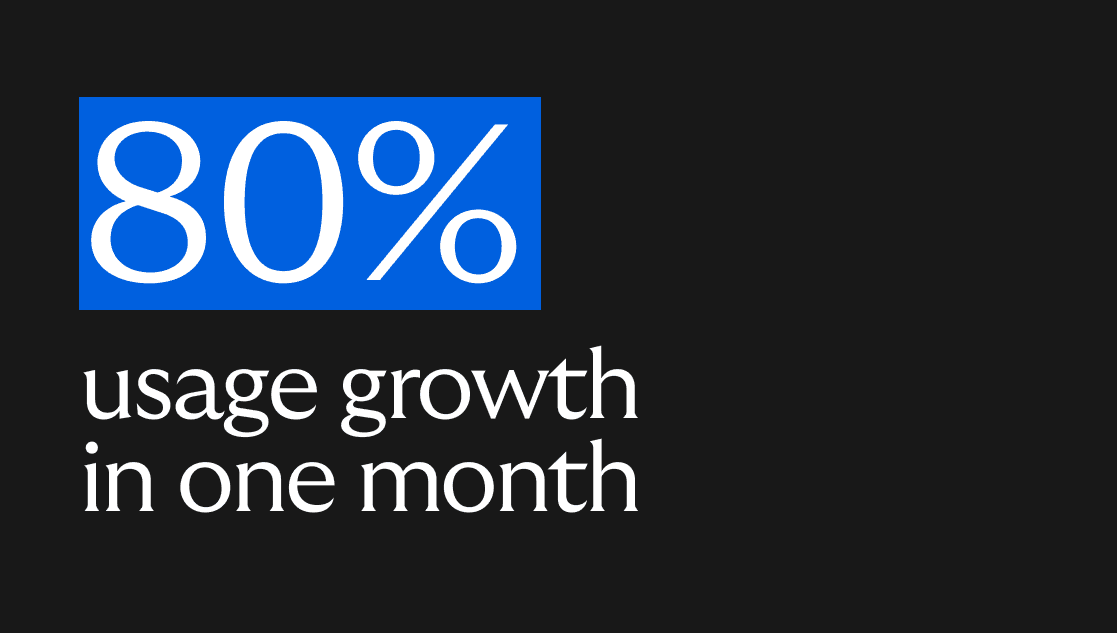
Jessica and Christopher understood this from the start. Usage grew 80% in February from the January launch month, then increased by a further 43% in March, reaching 6,843 interactions across the global legal team. That trajectory was not accidental. It came from treating adoption as an operational discipline: planned, measured, nurtured and managed.
Training gets legal professionals through the door. What keeps them coming back is Wordsmith embedded into the work itself - present at the moment a contract lands, not remembered after the fact.
"The objective was never simply to provide access to a legal-grade AI tool. It was to ensure that usage patterns, risk posture, and value realisation could withstand scrutiny from legal leadership, and both enterprise AI governance and investment stakeholders."
Christopher Allen, Senior Corporate Counsel
The Three-Phase Deployment Model
The instinct in most enterprise rollouts is to move fast and measure later. Belron did the opposite. They structured their deployment across three sequential phases, each with a defined goal and a clear metric that had to be met before moving on. Not a calendar. A standard.
Phase 1: Stabilise. The first question is not who loves the tool. It is who has not touched it. Belron's goal was simple: get every licensed user to at least one meaningful interaction per week. That meant targeted outreach to zero-interaction users with role-specific use cases, not a general awareness email. A specific use case, relevant to their practice area, with a reason to try it today.
Phase 2: Deepen. Once the floor is established, the work shifts. Frequent users become high value users. Top use cases get captured and standardised. And measurement shifts. Phase 2 is where time saved and cost avoided start to appear in the data.
Phase 3: Sustain. This is where most deployments plateau. Belron's answer is to make Wordsmith non-optional, integrated into standard workflows cross-regionally. Belron is currently running seven initiatives to get there.
Targeted Outreach & Email Nudges – Re‑engage low and non‑using team members through segmented, role‑specific outreach highlighting concrete, relevant Wordsmith use cases.
Office Hours Training – Provide live, workflow‑based training sessions focused on real legal tasks at Belron to build confidence and baseline proficiency.
Use Case Library Build‑Out – Create a centralized, searchable repository of team‑submitted workflows documenting tasks, prompts, and time saved.
Workflow Automation Challenge – Crowdsource high‑value, repeatable legal workflows that accelerates adoption through peer participation and recognition.
Power User Mentorship Program – Pair Power Users with lower‑engagement users in structured mentorships to accelerate practical, workflow‑driven adoption.
Biweekly “Did You Know” Content Engine – Deliver short, practical tips and copy‑paste‑ready prompts to reinforce learning and sustain usage momentum.
KPI Survey & ROI Capture – Quantify business impact through quarterly surveys measuring time saved, cost avoidance, and value realized to enable leadership‑ready ROI reporting.
Use Cases That Drove Measurable Value
In-house legal teams are under pressure to do more with the same headcount. The use cases below are not a feature list, they are the workflows where Belron's legal team found that Wordsmith changed what was possible in a day.
Contract review and redlining. The first pass on a third-party agreement, extracting key terms, flagging deviations from the playbook, comparing versions, is time-consuming and low-judgement. Wordsmith handles it. Legal professionals spend their time on the work that matters.
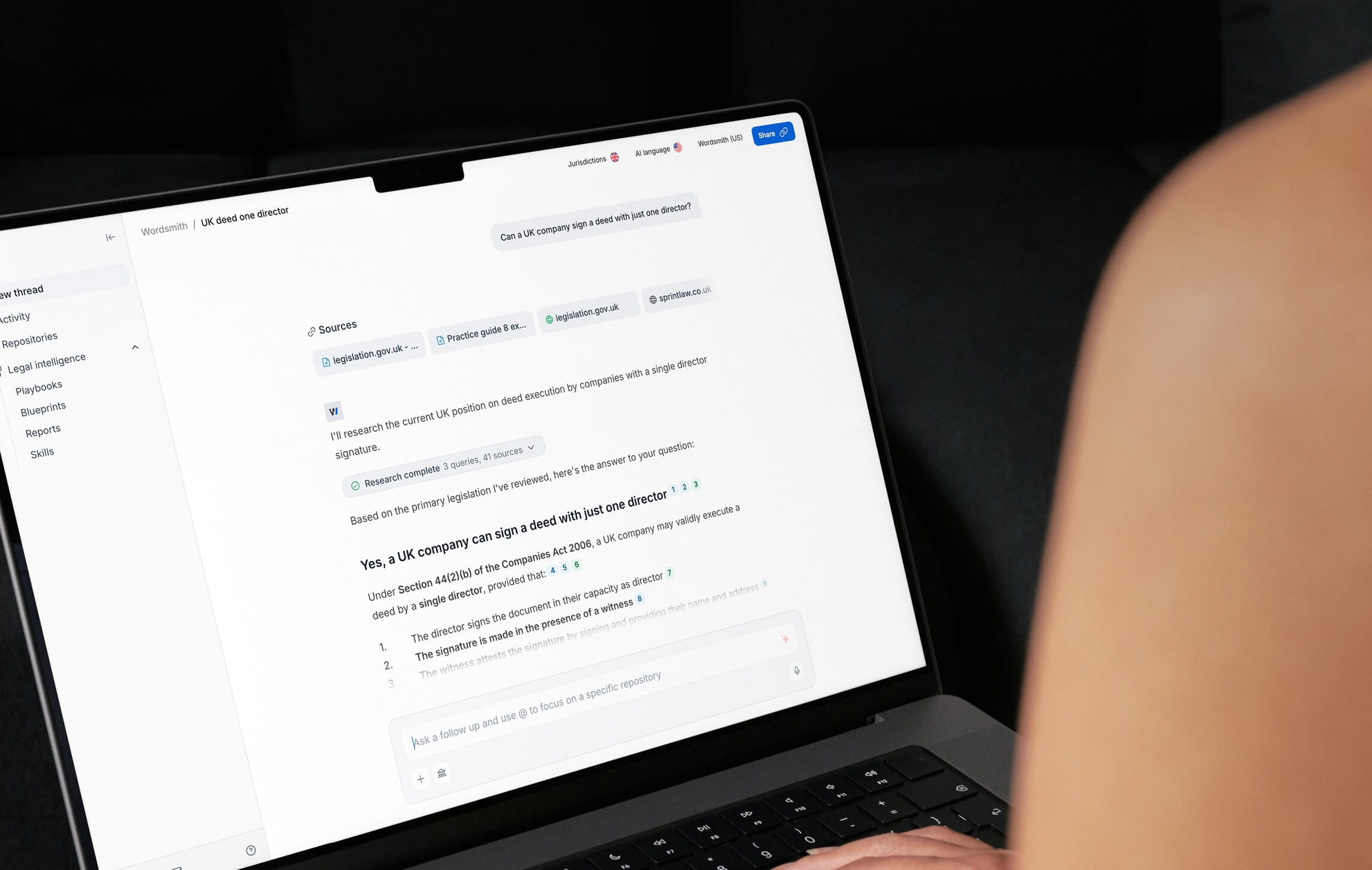
Legal research and issue spotting. Regulatory analysis, director duties assessments, employment law questions. Wordsmith accelerates first-pass analysis so the rest of the business arrives at the substantive question faster.
Policy and privacy notice review. The GDPR backlog is real in most legal teams. Structured summaries and gap identification turn a slow, manual process into something that can actually be kept current.
Risk and/or impact assessment. Volume of associated documentation and regulatory complexity is the problem. Wordsmith handles issue extraction, factual summaries, and scoring and mitigating identified risks across large document sets. Legal professionals handle the judgement calls and mitigation implementation.
Regulatory horizon scanning. Automated agents monitor legislative changes and map them against existing contract repositories. The team stops reacting to things that have already happened.
Measuring ROI at Enterprise Scale
At some point, a GC will be asked to justify the spend. Interaction counts will not be enough. The transition from adoption metrics to ROI metrics should be planned before the end of the first quarter, not after leadership asks for it, and regularly tracked thereafter.
Category | What to measure | How to capture it |
Time savings | Average time saved per legal professional per day | Structured quarterly survey, attributed to specific use cases. |
Usage Frequency | Percentage of weekly tasks using Wordsmith | Percentage bandings in 10% increments |
Cost avoidance | External counsel and vendor spend reduced or avoided | Self-reported by users with matter description and approximate value. |
Quality improvements | Consistency, first-pass accuracy, reduction in revision cycles | Qualitative feedback tied to specific workflows. |
Legal team satisfaction | Team sentiment to capture personal experience and perception narratives | Open ended questions to extract themes and feed into future initiatives |
“Usage tells you lawyers are in the tool. ROI tells you why it stays in the budget. The gap between the two is where legal ops operates, and that’s where we started. That’s the difference between access and impact.”
Jessica Vander Ploeg, Vice President, Legal Operations
Pre-Launch Checklist
The steps most teams skip are not the obvious ones. They are the ones that feel like they can wait. They cannot.
1. Identify Power Users before launch: seed them with early access and use cases to generate internal proof points and evangelise.
2. Build a teaser communication that creates anticipation, followed by a formal go-live announcement.
3. Schedule live training within the first week: a workflow session using real team artifacts and problem statements, not a feature demo.
4. Set up usage monitoring segmented by region, role, and adoption engagement level from day one to drive targeted interventions and monitor cause and effect.
5. Accept that a multifaceted and multitouch approach to achieve sustained organizational change management requires persistence, creativity, psychology and leadership endorsement. Expending political capital won’t hurt either.
About Belron. Belron is a global enterprise with over 30,000 employees operating across brands including Autoglass, Safelite, and Carglass. Their global legal team spans the US, Canada, Australia, New Zealand, the UK, and the EU. Belron’s adoption journey by the numbers.
March exceeded all prior benchmarks, by outperforming both trial (October 2025) and early post‑launch months, marking Wordsmith’s transition from experimentation to embedded workflow usage.
Adoption concentration decreased over time, with Power Users driving ~70% of usage in January but ~61% by March, indicating an improving breadth of adoption.
Regular‑tier, (i.e. second quartile) users generated ~25% of all Wordsmith interactions by March, materially expanding the middle of the adoption curve and reducing reliance on a small set of expert users.
Top users continued ramping rather than plateauing, with several leading contributors increasing their usage 40–70% month‑over‑month from February to March.
About Wordsmith. Wordsmith is the AI platform for in-house legal teams. It gives them the infrastructure to manage all their work in one place and extend legal support across the business without adding headcount. Customers include the Financial Times, Next, BT, and Belron.