ARTICLE
Wordsmith raises $70m to build the platform to run your in-house legal team
Today we're announcing our $70M Series B, taking our total funding to $100M. We are building the platform legal teams use to run their entire operation: an inbox that does the work, where requests come in, get handled, and land with the legal team ready to review. Over time, that means more work handled in-house, less unnecessary external counsel spend, and a legal function that can move at the speed of the business. Over the past 12 months, revenue has grown by over 14x. More than 500 companies now run on Wordsmith.


What we believe
Every other function in the business has a system. Sales has a CRM. Finance has the ledger. Engineering has Jira. Legal has a Slack channel, a pile of inboxes, chat threads, and half-finished documents behind it.
That's the problem. Not lawyers. Not speed. The function is invisible because it has never had a system to run on.
We made a bet when we started Wordsmith: in-house legal would become one of the most important functions of the AI era. The business would move at the speed of AI, and legal would have to keep up.
Two years in, that's playing out faster than we thought. The business has stopped waiting. It answers its own legal questions with whatever tool it can find. Risk builds up where the legal team never sees it. Work happens without legal knowing, owning, or recording it.
We built Wordsmith to be the system legal never had.
The problems we're building to solve
We talk to GCs, Heads of Legal Ops, and CFOs every week. The same problems come up, in the same words. This is what we're building against, in order.
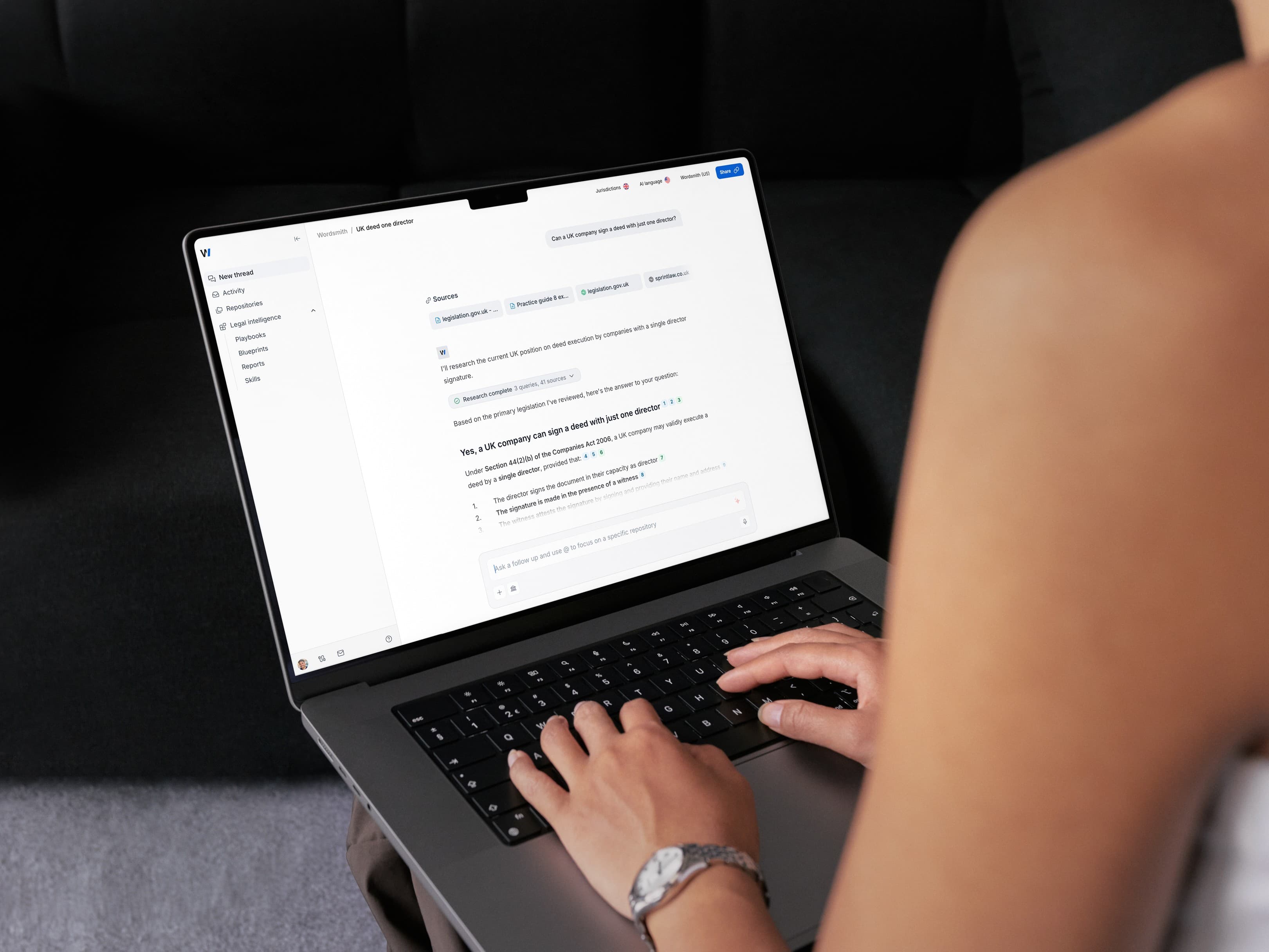
- Routine work eats the team and the outside counsel bill keeps growing. NDAs, vendor reviews, privacy questionnaires, the same contract questions for the tenth time this quarter. Named AI workers for privacy, contracts, vendors, and counsel do the routine inside the platform, against your playbooks, with SLAs. Every job done in-house is one less invoice from a firm. This is happening now.
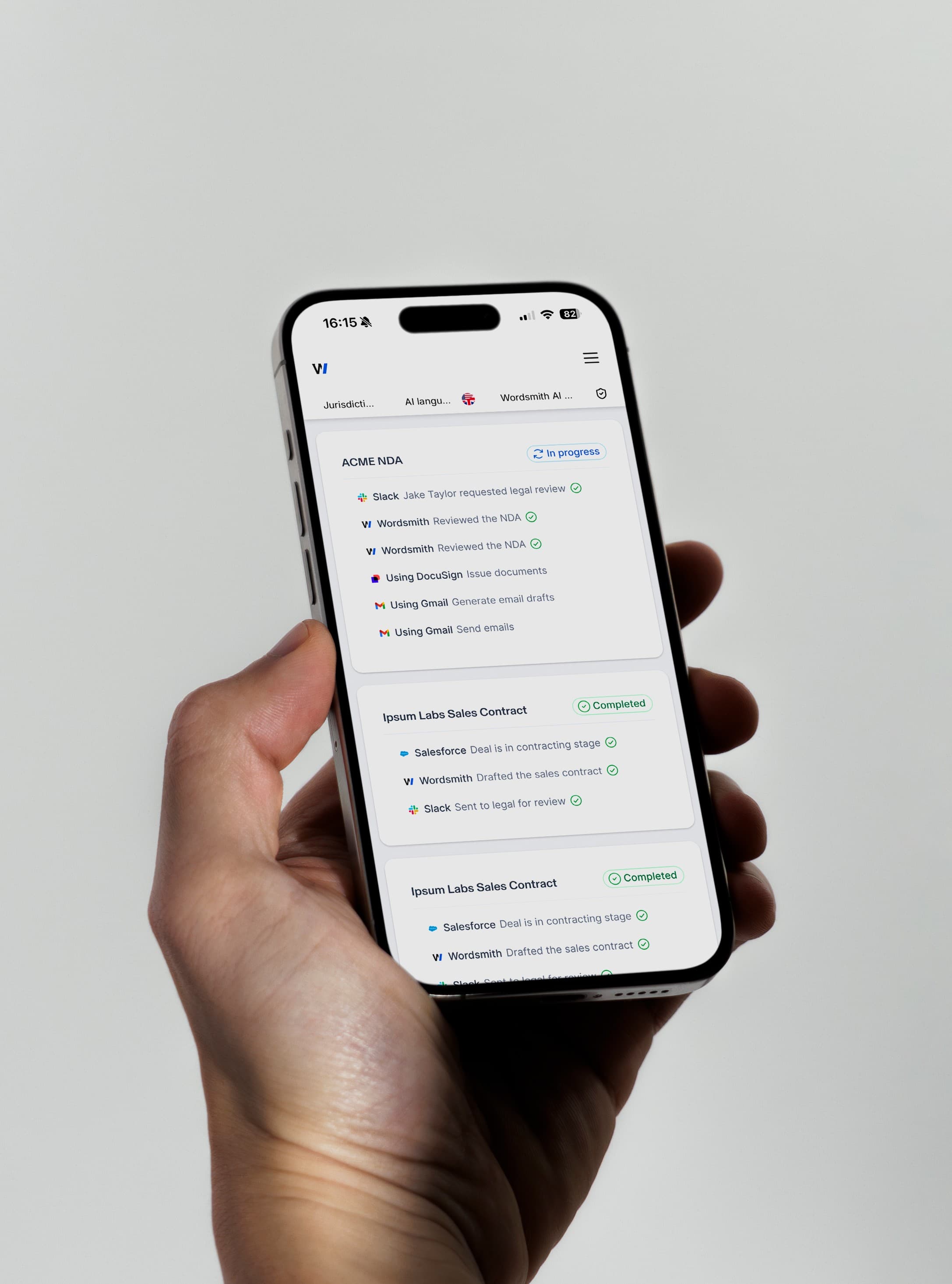
- You can't see your own queue. Requests come in through Slack, email, Salesforce, Teams, a tap on the shoulder. Too much never reaches legal. The work that does often lacks a clear owner, status, or next step. We're building the inbox: every channel becomes an input, and every request lands in one place with an owner, from the moment it arrives. Q2 2026. This is the wedge.
- Work has no owner and no context. A request without an owner stalls. A request without context is a request a lawyer has to chase before they can start. In Wordsmith, every job becomes a matter: owner, SLA, stakeholders, and context attached. Q3 2026.
- The CFO asks what legal costs and nobody can answer. Outside counsel spend keeps rising. The function can't show what it did, what it saved, or what it kept in. Wordsmith reconciles what should happen against what did happen: playbooks, obligations, spend, and decisions in one place. For the first time, the function has a number, and the CFO has a clear line of sight into what is changing. Q4 2026.
That's the roadmap. Each step is built against a real problem real customers told us about. No shelfware. No "AI for everything."
How we'll build the company
We build for the function. Legal serves everyone else in the business. If the product only works for the lawyers, it misses the point. Wordsmith has to work where the business works, and bring legal in when judgment matters.
We're hiring against the roadmap, not the org chart. Engineers and legal engineers sit together. The product team is led by people who ran in-house legal teams, because the people closest to the problem build the best version of the answer.
We're scaling to around 300 people by the end of the year, across the US, UK and EMEA. The team grows where the customers are.
We are staying focused on in-house legal. Law firms and in-house teams have different incentives, different workflows, and different definitions of success. We cannot build for both sides at once.
What this round is for
This funding goes into the platform and the legal engineering at the heart of it. Into the inbox, the matter layer, the workers, and the number. Into the team that ships them. Into the customers already pushing us: more product, shipped faster, against the problems they actually have. And into the long-term bet: that the company that builds the operations platform for in-house legal will be one of the most important software companies of the next decade.
The function deserves a number. We are going to give it one. And with that number, the outside counsel bill starts coming down.
About Wordsmith
Wordsmith is the legal operations platform for in-house teams: the inbox that does the work. It takes every request from the business, routes it to the right owner, resolves the routine with AI workers and approved playbooks, and reconciles what should be done against what was done. So legal moves at the speed of AI, the business gets answers, and teams get clearer control over outside counsel spend.